
Banking News – Acting Prime Minister and Minister for Energy, Water Resources and Irrigation Biraj Bhakta Shrestha has expressed commitment to making the Bagmati and Bishnumati rivers clean again and developing Kathmandu as a safe and livable city. Addressing the Kathmandu Climate Action Week as chief guest, Shrestha, who is also a member of parliament from Kathmandu Constituency No. 8, unveiled concrete action plans on behalf of the federal government for river conservation, flood control, and urban environmental improvement.
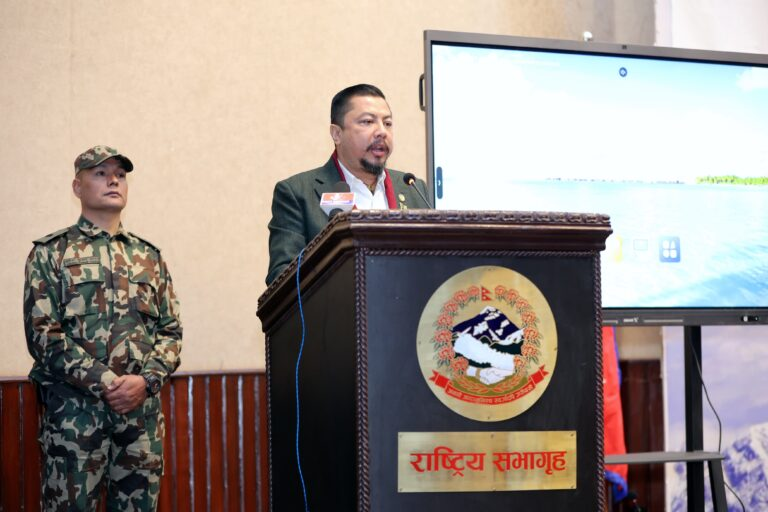
During his address, Shrestha recalled his childhood, sharing his experience of drinking clean water from the Bishnumati and Bagmati rivers, bathing in them, and growing up amid green fields and the chirping of birds along the riverbanks. But he said he becomes very emotional seeing those rivers becoming polluted and crisis-stricken within his own lifetime. He noted that with haphazard concrete structures built over recent decades, fields, ponds, and open land have been destroyed, the city's temperature has risen, dust and smoke have blackened centuries-old temples and heritage, and the risk of flooding has become dire as there is no land to absorb rainwater.
Noting that climate change has added to the crisis, Shrestha said the arrival of massive floods carrying large boulders and debris in three river corridors within just 46 days, avalanches, and melting glaciers are serious warnings. He urged other municipalities in the country undergoing rapid urbanization to learn from Kathmandu's mistakes and protect rivers, ponds, and open land in time. He also praised Kathmandu Metropolitan City, its acting chief, and ward chairs for their role in reviving old stone spouts (hiti) and royal water conduits that were on the verge of disappearing over the past four years and in protecting underground water reserves.
In his address, Acting Prime Minister Shrestha also outlined the government's main commitments and plans. According to him, a flood early warning and glacier monitoring system will be established. So that wards and households can receive information before floods arrive, coordination will be made with the metropolis and other cities through the Department of Hydrology and Meteorology on rainfall measurement, urban flood modeling, and early warning systems. Experts, scientists, activists, and youth will be engaged in monitoring hanging ice cliffs and melting glaciers.
Likewise, nature-based river conservation will be carried out. Instead of confining rivers within rigid concrete walls, they will be allowed to spread and contract naturally. The sources at Bishnudwar and Bagdwar and the areas of Nagarjun and Godavari will be protected. Since rivers do not recognize administrative boundaries, the Department of Water Resources and Irrigation and the Ministry of Physical Infrastructure will coordinate with Kathmandu Metropolitan City and 17 surrounding municipalities connected to the river system to begin work before the coming monsoon.
Similarly, the city will be made cooler and groundwater recharge will be carried out. After the metropolis identifies locations for rooftop rainwater harvesting in every household, water-absorbing footpaths, open spaces, and planting of native trees along main roads, the federal government will provide financial and technical support. Likewise, air pollution will be controlled. Emphasis will be placed on electric public transport, clean brick kilns, and waste incineration control in line with the Nationally Determined Contribution. Air quality data will be kept open for citizens, and pollution control preparations will be completed before winter and smog begin (before October).
Similarly, energy from waste and climate finance will be mobilized. An appeal has been made to sort waste at home to speed up the operation of the Teku biogas plant and the agreement between the Alternative Energy Promotion Centre and Kathmandu Metropolitan City. Minister Shrestha said work will be done together with the Town Development Fund to bring in green bonds and climate funds through the Climate Finance Summit. He said the need was felt for a fund that can be mobilized quickly for recovery after the Bhotekoshi disaster.
Praising the activism of youth in new technology, Shrestha gave the example of Grade 12 students building a communication system that sends disaster alerts without a mobile network. He stressed the need to move forward by combining the technology of youth with the traditional water system knowledge of senior citizens. Raising the issue of climate justice, Shrestha said that although Nepal's contribution to global carbon emissions is negligible, Nepalis have to suffer from melting glaciers and floods and landslides. He said true justice lies in protecting the river, sources, trees, birds, and wildlife habitats along with the residents living on riverbanks.
At the end of his address, Shrestha presented a vision of cool, tree-filled streets, historic neighborhoods and settlements reachable within a 15-minute walk, returned stolen statues, cycle lanes, a clean Bagmati-Bishnumati corridor with the chirping of birds, forests around Kathmandu, and the ecological balance of national parks. He called on everyone to jointly build a beautiful Kathmandu where parents can confidently bask in the sun in parks, children can play safely in squares, and green modern commercial centers thrive.
Comments
Thank you! Your comment has been received. It will appear here once it is approved.